What is a quick commerce app?
A quick commerce app delivers groceries and essentials in 10 to 30 minutes using nearby dark stores, small, delivery-only warehouses. It is different from a regular grocery app because it relies on real-time inventory and hyperlocal logistics, not big stores or next-day delivery.
Core features include real-time GPS tracking of riders, AI-powered product suggestions, and fast payment options like UPI auto-fill. These help you convert orders quickly and reduce cart drop-offs.
Real-time inventory is needed because stock in dark stores changes fast. A customer must see what is actually available, not what was listed hours ago. Without live sync, you risk overselling and failed deliveries. For example, if a phone is sold online but not updated in the app, the next buyer sees it as available, that breaks trust.
How to build a quick commerce app covers the full process, from store setup to launch.
Can you start with less than three apps?
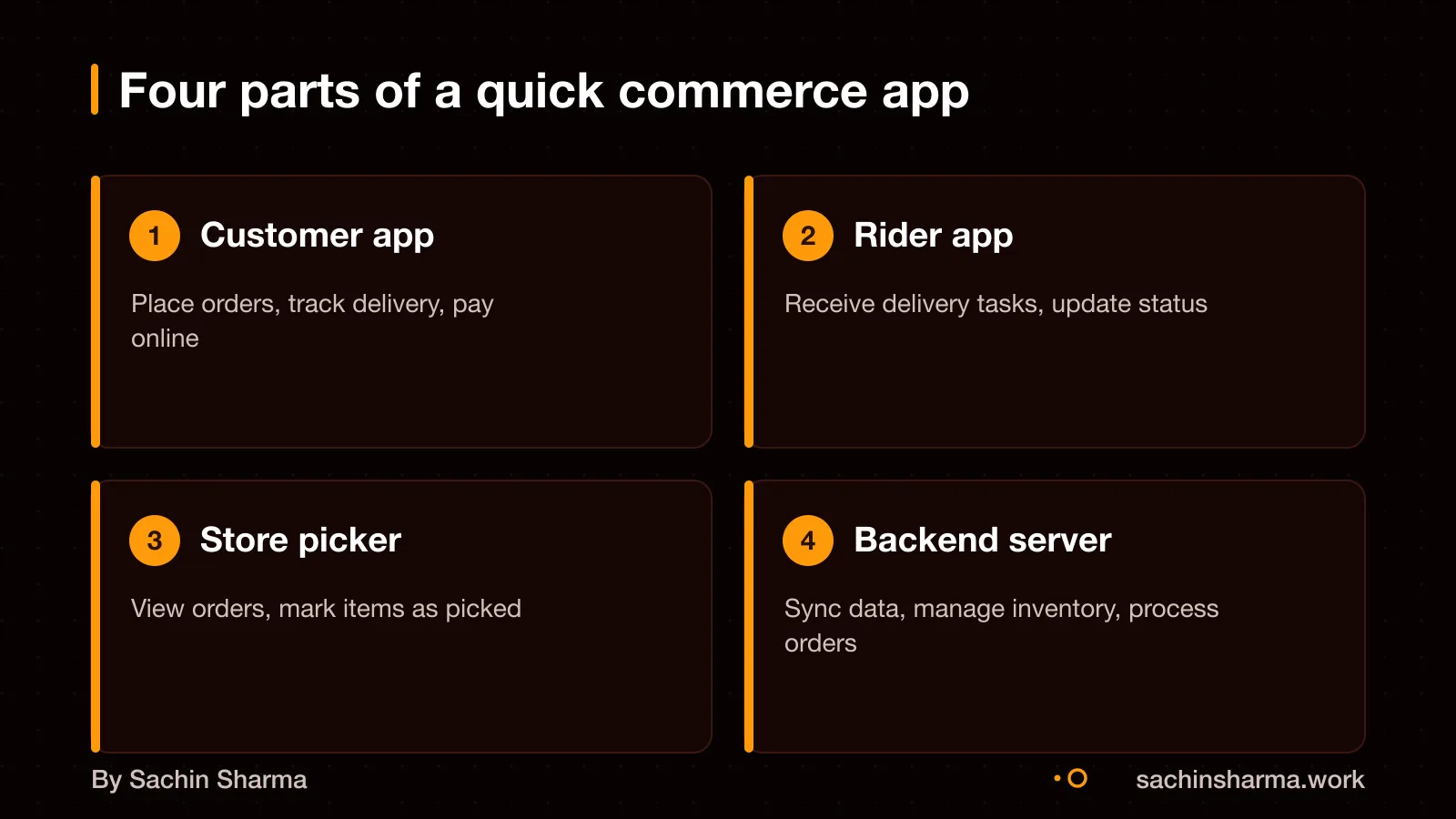
Yes, you can start with just the customer app and admin panel, and use third-party riders instead of a rider app. This cuts cost and launch time. A full quick commerce app serves customers, stores and riders. But you do not need all three at launch.
You do not need a rider app at the start. Instead, use a third-party driver network like DoorDash Drive or Onfleet. This cuts the initial build cost by $40,000 to $80,000. The drivers get orders via the partner network, not your app.
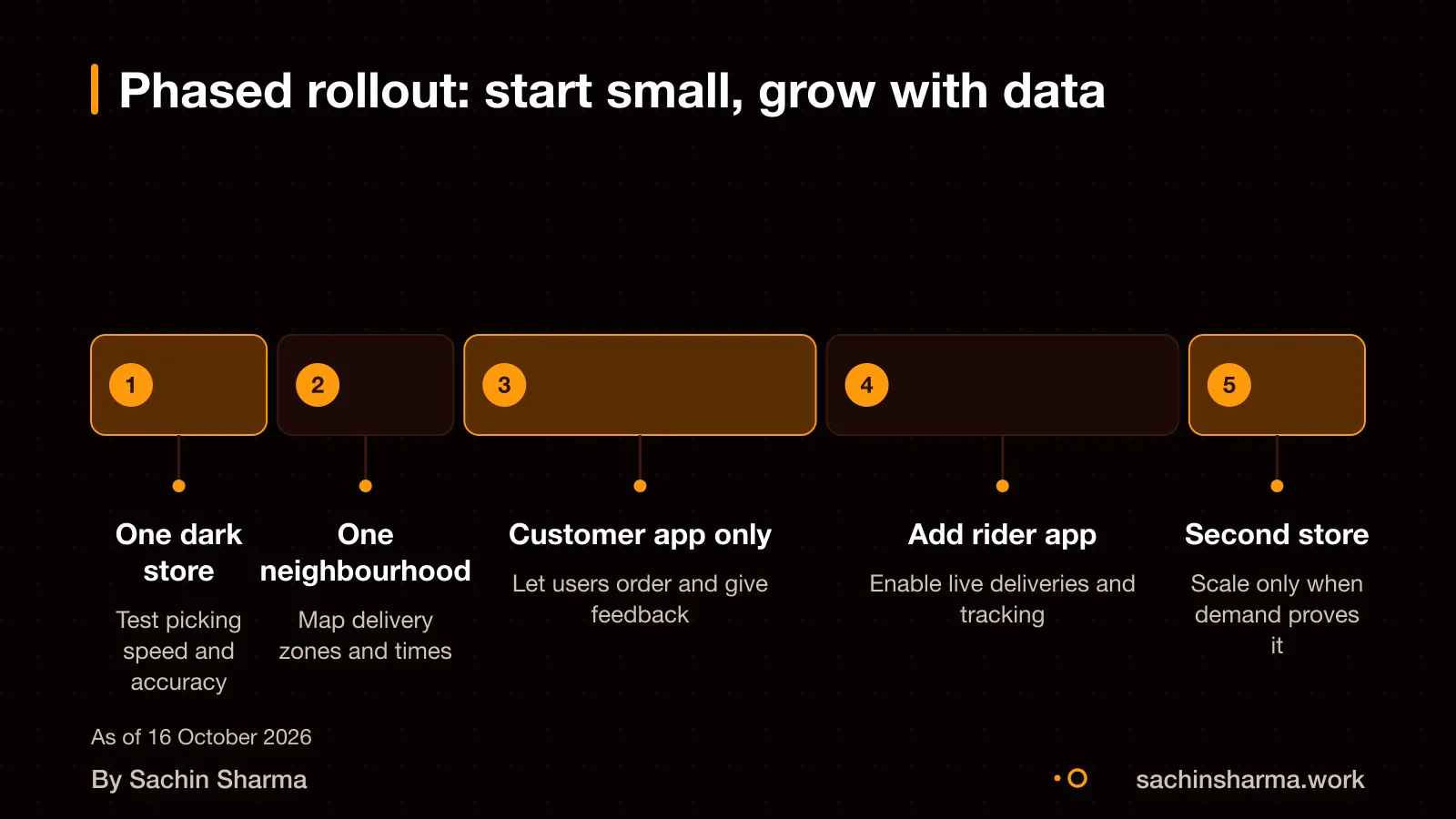
You can skip the store picker tool at first. Start with one store in one area. Let customers order only from that store. Add more stores and a picker later, when demand grows.
The cheapest way to launch is: (1) a customer app with browsing, cart and checkout. (2) an admin panel to manage orders and inventory, and (3) third-party delivery integration. This proves your idea with real users before spending more.
Build or buy a quick commerce app to see if a white-label solution fits your budget.
What changes the price the most?
The biggest cost drivers are the features you choose, app complexity, design quality, platform (iOS, Android or both), and third-party integrations. Advanced features like AI recommendations or real-time tracking raise costs the most. Building for both iOS and Android adds time and testing, but using a cross-platform framework like Flutter can be more budget-friendly.
Integrations add cost because they require secure, reliable connections to outside systems. For a quick commerce app, this includes syncing with your dark store inventory, live order tracking with maps, rider assignment logic, and payment gateways. Each integration needs custom code, error handling and testing. Third-party services also charge ongoing fees for transactions, SMS, and cloud maps.
Hidden and ongoing costs include monthly hosting, API usage (like Google Maps), payment processing fees, and SMS alerts. These can total $8,000 to $25,000 per month for a live app. As an estimate, annual maintenance costs 15 to 20% of the build cost. This covers updates, bug fixes, and compatibility with new OS versions.
For example, adding real-time rider tracking with live ETA updates needs GPS sync, map rendering. Server load management, all of which increase development and running costs. If your dark store uses a legacy system, syncing inventory in real time may need custom middleware.
Want a number for your idea? Send one line on WhatsApp. I reply with what drives the cost and what to cut.
Message me on WhatsAppHow long does it take to build?
An MVP quick commerce app takes 4 to 6 months to build, based on a project costing $40,000 to $80,000. This includes core features like user signup, product listing, cart, checkout, payment, order tracking, and basic admin controls. The time can vary based on how fast you review and approve each phase.
A single-brand ordering system for a food delivery app takes 10 to 14 weeks to build. This version focuses only on order placement and fulfilment for one store, with minimal extras. It suits businesses testing demand in one location.
You can speed it up by limiting scope. For example, launching with cash-on-delivery only, manual inventory updates, and no rider app cuts development time. Using pre-built tools for payments and notifications also helps.
I use Flutter and Next.js in projects like Daily and MojoCinema.
For more detail on each phase, see the guide on How long to build a quick commerce app.
How does an engagement with me run?
An engagement with me runs in clear phases: scope, design, build, test and launch. Each phase ends with a review and a milestone payment. You pay only when a stage is complete, not upfront for the whole project. This keeps risk low and progress visible.
First, we finalise the scope. We define what the MVP includes, one store, one area, core flows only. This ensures you pay only for what proves the business. Then I design the key screens and flows, focusing on speed and simplicity.
Next, I build the app in weekly sprints. Every two to four weeks, a working version reaches a milestone. You review it and release the next payment. For example, the first milestone may include user signup, login and profile. The second, product listing and cart.
After core features are built, I integrate payments and order tracking. Then I set up the admin panel so you can manage inventory and orders. Each part is tested as it is built.
Before launch, I run final checks: performance under load, payment success rates and rider assignment logic. You get a ready-to-publish app, not just code.
The process follows six phases, each critical to market success. Milestones ensure steady progress and shared accountability. You stay in control at every step.
Have a quote in hand? Send it to me and I will mark what is missing.
Message me on WhatsAppWhat are the biggest risks and how are they reduced?
Stock inaccuracy is the top cause of order cancellations. If the app shows an item in stock but the dark store does not have it, the order fails. To reduce this, I set up daily inventory syncs and use a 5% variance rule:. If the recorded stock changes by more than 5%, a physical count is triggered to correct it. You must confirm stock levels with your team each morning.
Delivery delays often come from unclear rider routes or too many orders in one area. To avoid this, the app groups orders by delivery zone and sets time-based batches, like lunch or dinner rush. A test preset called "Lunch Rush" simulates 80 customers placing orders at 1 per second. With a database pool of 5, to check for queuing and delays. This helps tune the system before launch.
System crashes during peak times happen when too many users overload the server. To prevent this, the backend uses auto-scaling on cloud infrastructure and caches key responses. The same "Lunch Rush" test checks how the system behaves under load. If response times rise above 1.5 seconds, we add more server capacity or optimise queries.
Testing under real load is part of the build process. Each major release runs through simulated peak scenarios, including flash sales and weekend rushes. This ensures the app stays stable when it matters most.
How is the app tested under real load?
I simulate evening rush using two test presets: 'Lunch Rush' and 'Chaos'. Lunch Rush checks how the app handles 80 customers placing one order per second with a database pool of 5. Creating moderate pressure and some queuing. Chaos pushes the system harder with 400 customers and 3 orders per second using only 3 database connections. Which often causes a high error rate and severe bottlenecks.
During these tests, I track response time and error rate to spot performance issues. If response times rise or errors increase, I review the database queries, adjust connection pooling, or simplify heavy API calls. For example, under Chaos conditions, I might increase the DB pool size or add caching to reduce load. This helps the app stay stable when real users flood in during peak hours.
Proof: apps I’ve built
I have built full-stack apps with real-time data, offline support and complex user flows. The GitHub project "Sharma Quick Commerce" is a full-stack e-commerce web application built with Angular and Java Spring Boot. It shows my ability to work across frontend and backend systems, though it is not a live product or a Flutter app.
Among my shipped apps, MojoPlay has real-time "Listen Together" sessions over a live socket. Daily supports offline quizzes and streak tracking. Sameframe uses SHA-256 hashing and visual similarity models for exact and near-duplicate detection without uploading data.
FlashDrop uses LAN-only transfer with QR login and encrypted chunks, built in Next.js and Flutter. One Tap Recorder captures 4K screen video with no network access or permissions. These prove I can build secure, high-performance mobile apps.
The source for Daily, MojoPlay, MojoCinema, Sameframe, FlashDrop and DevDex is closed, but the READMEs describe the tech and architecture. The Sharma Quick Commerce project on GitHub is a learning project, not a client app or production system.
Who owns the code and can you switch later?
You own the app’s code and can move it to another developer later, as long as the contract says so. I will give you all source files, design assets, and documentation needed to hand over the project. This includes the app’s bundle ID, which stays the same even after transfer and cannot be changed once a build is uploaded.
To switch developers, you must share the full codebase and building assets directly with the new team. If your app uses Apple Pay, note that the merchant ID does not transfer. You will need to create a new one under the recipient’s Apple Developer account when submitting an update.
For legal and tax rules, GST applies to the service I provide, and you may claim input credit with a proper invoice. However, exact ownership terms depend on our contract. We will agree on them before work starts, so you know your rights.
If you ever want to take the app in-house or hire someone else, you can. I do not lock you in. You get full access to the code, version control, and deployment tools. Just make sure the new developer sets up payment and delivery integrations from scratch, as those are account-specific.
Support and maintenance after launch
I offer post-launch support to fix bugs, update dependencies, and keep your quick commerce app running smoothly. This includes security patches, OS update compatibility, and minor feature tweaks. For a ₹30 lakh app, that is ₹4.5 to ₹6 lakh per year.
I do not offer a fixed monthly maintenance package, as the work depends on your app’s usage and changes in device or platform rules. Some months may need no work; others may need urgent updates. You pay only for what is done, billed transparently per task.
I recommend setting aside a quarterly budget for updates and reviews. This helps plan for known cycles like festival sales or new Android/iOS releases. You own the code and can switch developers anytime.
The exact cost and scope of support will depend on your app’s complexity, integrations, and user load. Since my past projects include real-time and offline-first apps like MojoPlay and Sameframe. I am equipped to support apps with live data and high reliability needs.
Related reading: Best tech stack for a quick commerce app.
Assumptions behind the numbers
- Assumes 40 screens
- Assumes one payment gateway
- Assumes one dark store
Work out your own number
I won't hand you a number that pretends to be the market. Instead, here is the working: set the weeks, the people and the rate, and see where the money goes.
Your working total
₹5,60,00014 weeks × 2 people × 5 days × ₹4,000- Scope and design14%
- Build57%
- Testing and fixes14%
- Launch and stores14%
The weeks shown are an example of a small app, there to be changed. Fees you pay others (store accounts, cloud, SMS) are not in this total.
What moves the price
- More screens or roles
Each extra user type (customer, admin, rider) is close to another app.
- Real-time features
Live tracking and chat need more design and more testing.
- Many integrations
Every payment, SMS, maps or ERP link is its own piece of work.
- Cutting to one platform first
Starting with one clear flow can be half the work.
- Using managed services
A managed backend for login and data removes weeks.
- A clear scope up front
Changes mid-build are the most expensive weeks.
Fees that go to someone else
Google Play developer account
A one-time registration fee, paid to Google. Check the current amount.
Apple Developer Program
A yearly fee paid to Apple. Check the current amount.
Cloud, SMS, maps, payments
Usage-based, billed by the provider to you.
Ask for these before you sign
- How many weeks per phase, and with how many people?
- What is not included?
- Which fees do I pay to others directly?
- What happens to the price when I change my mind?
- What does the first month after launch cost?
Questions people ask
A quick commerce app requires a multi-platform ecosystem serving three distinct user groups: end consumers, merchant partners, and delivery personnel. Each serves a different user group and must work together. You own the code only if your contract says so.
Pricing depends on the model we agree on: fixed, hourly or milestone-based. There is no set rule in the data. Discuss your budget and timeline with me to pick the right model for your project.
At each milestone, you get a working part of the app: design, build, test, or launch phase. Payments are tied to your approval of each deliverable. This keeps the project on track and clear.
Yes, the Sharma Quick Commerce app is public on GitHub and built with Angular and Java Spring Boot. You can review the code structure and tech stack there.
Scope changes must be agreed before work starts. There is no set process in the data. Any change that adds features or time will affect cost and delivery. We will discuss and confirm each change in writing.
Integration depends on your current system. It may be possible, but cost and effort vary. Share your system details so I can assess if and how it connects to the app.
The app uses UPI, maps, SMS, and cloud hosting. As an estimate, these cost $8,000 to $25,000 per month. Costs depend on user volume and service rates, which can change over time.
Yes, a no-code prototype helps test demand with less risk. Tools like Glide or Adalo can build a working model fast. This lets you validate the idea before spending on custom code.
Stock must sync in real time when an item is picked. If the app shows stock but the store does not have it, and variance is over 5%, do a physical recount. This keeps orders accurate.