What is Flutter and why use it for a first app?
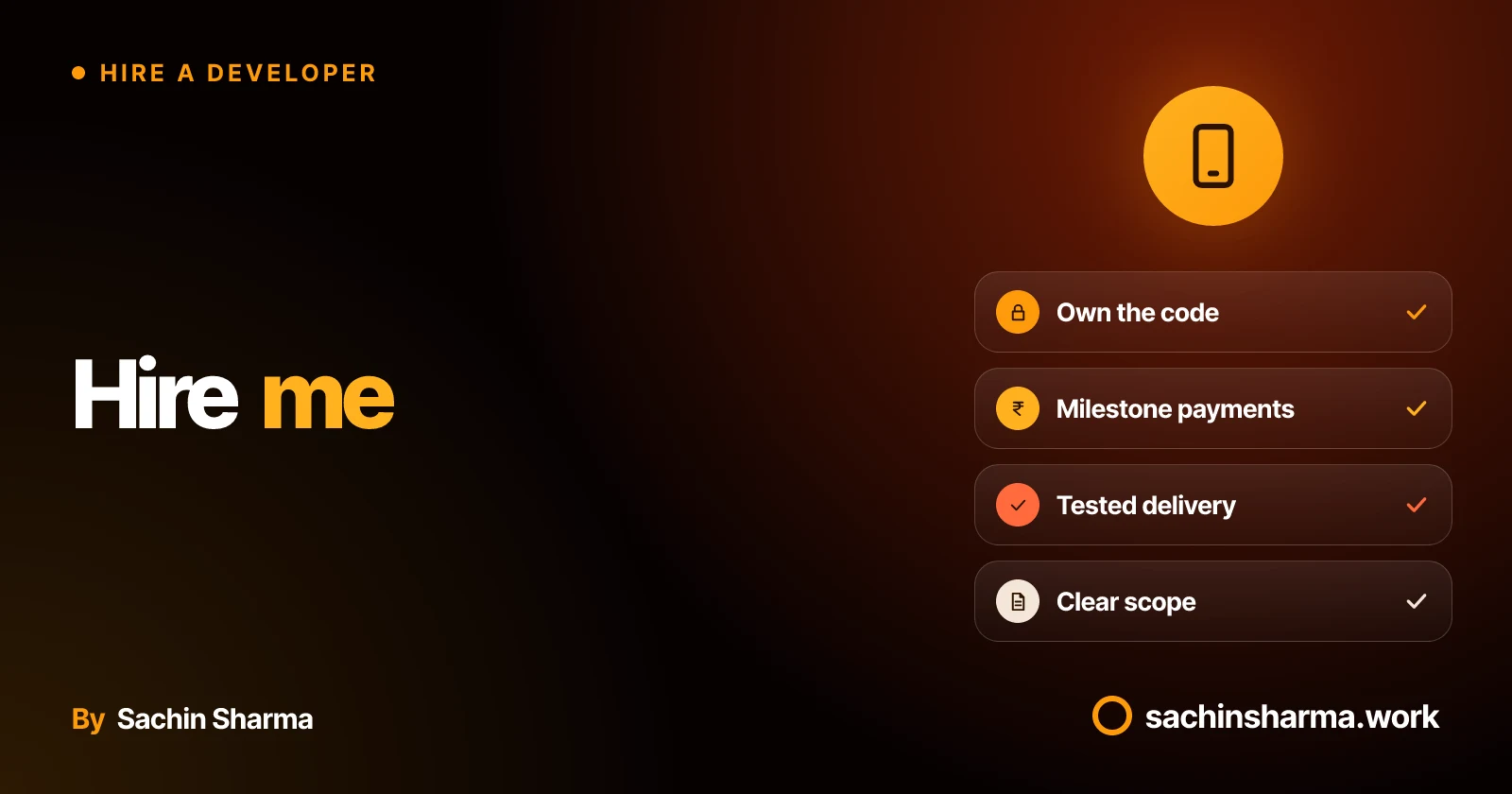
Flutter is a cross-platform software development kit (SDK) that lets one codebase run on iOS, Android, web, and increasingly desktop. This means you write the app once, and it works on all major platforms. For a first app, this cuts both time and cost. Flutter development typically costs 30 to 40 percent less than building two separate native apps. That saving comes from shared code, design, and testing across platforms.
Flutter aims to be the most popular, fastest-growing, and highest-productivity multi-platform UI framework. As of March 2026, it holds roughly 46% of the cross-platform framework market. This wide use means better tools, more plugins, and faster updates. For your first app, Flutter reduces risk by letting you test your idea on both iOS and Android without double the budget.
For example, if a native app pair would cost ₹10 lakh. A Flutter app might cost ₹6 to ₹7 lakh as an estimate, assuming similar features and quality. This makes Flutter a practical choice for Indian businesses testing an app idea. You reach more users faster, with less upfront spend. If you later add web or desktop versions, Flutter supports those too with minimal extra work.
You can compare this with native development to see which fits your goals Native or cross-platform: which one for your app?.
What it costs to hire me for your first Flutter app
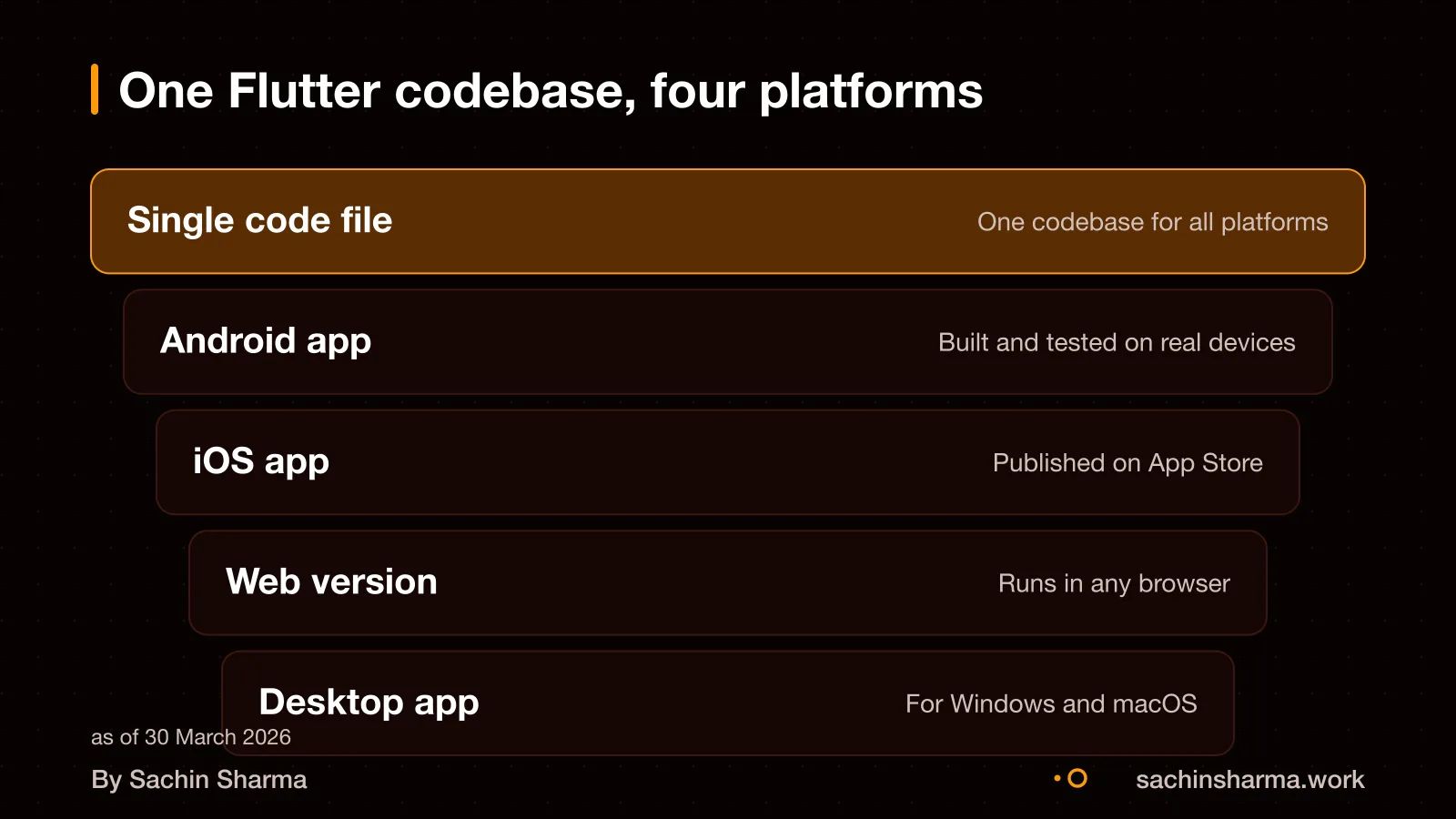
A mid-complexity Flutter app in India costs $15,000 to $60,000. Flutter app development cost in India starts at $8,000 for a simple MVP. The final cost depends on features, design depth, backend needs and third-party tools. More screens, user roles, real-time sync or payment flows raise the cost. Using templates, limiting scope and reusing open-source tools can lower it. Agencies often add 30 to 50 percent markup over freelancer rates. As a solo developer, I do not charge an agency margin. My rate fits within India’s senior Flutter developer pay band of ₹21 to 45 lakh per year. For a full breakdown of cost drivers, see What does a Flutter app cost?.
Want a number for your idea? Send one line on WhatsApp. I reply with what drives the cost and what to cut.
Message me on WhatsAppHow long it takes to build your first Flutter app with me
A mid-complexity Flutter app takes 3 to 5 months to build. This timeline assumes a clear scope, timely inputs from you, and no major changes during development. If the app is more complex, it may take 5 to 9 months.
Delays usually come from unclear requirements or late feedback. For example, if you delay sharing content, login details, or approval on key screens, the schedule slips. Changes in features after coding starts also add time.
We stay on track with a written scope that lists what is included and what is not. You get working versions every few weeks to review. This keeps surprises low and progress visible.
For a real-world example, see how long a quick commerce app took Hire a developer for a quick commerce app.
How an engagement with me works
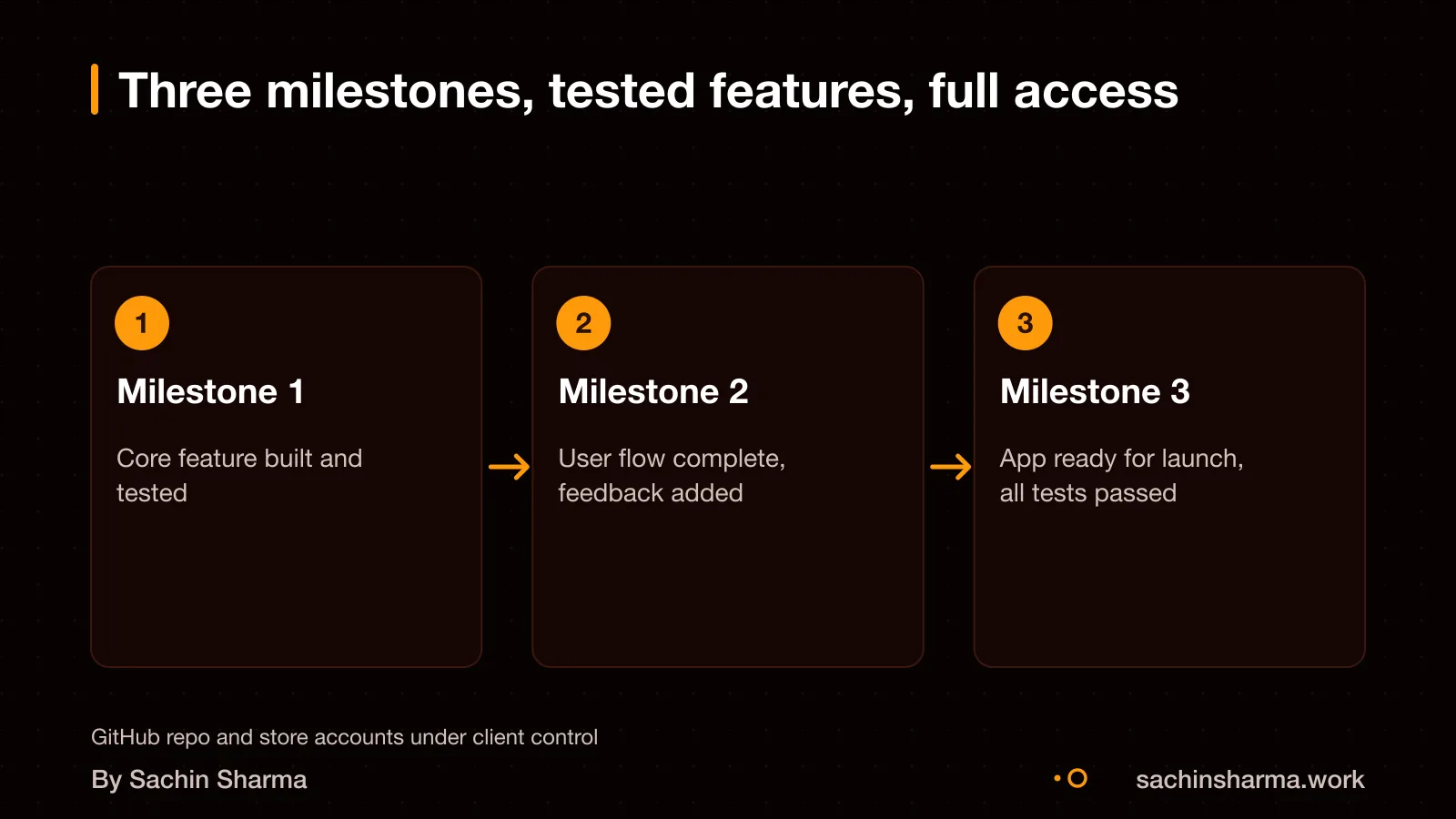
You start with a call, sign an NDA and IP transfer on day one, then work in two-week cycles with tested features delivered each time. I work directly with you, not through an agency. Each milestone is a shippable feature, tested and shown to you. We use GitHub for code and Figma for design, both shared with you from the start.
Communication is over WhatsApp or email, with weekly updates. You get access to the project’s GitHub repo and Figma files so you can see progress anytime. At each milestone, I show you the feature on a test device or web link. You approve it or request changes before we move on.
I have shipped several Flutter apps. MojoPlay is a music app with real-time “Listen Together” sessions, offline downloads and mood-based discovery. Daily is a current-affairs app for exam aspirants with daily quizzes and streak tracking. Both are public showcase apps with closed source, as noted in their READMEs. You can visit MojoPlay: a Flutter music app with real-time Listen Together and Daily: a Flutter current-affairs and quiz app to see how they work.
The process starts only after paperwork is complete. This protects your idea and ensures you own the app from day one. Witarist signs NDA and IP transfer on day one. You are never locked in, and you can pause or stop at any milestone.
Who owns the code, design and store accounts?
You own the code, design and store accounts from day one. A written contract assigns intellectual property (IP) to you before any work starts. This means the source code, UI designs, and app store assets are legally yours, even if the project stops.
Your access to the GitHub repository matters because it proves you control the code. I set up a private repo and add you as an admin. You can see progress, download the code, and hand it to another developer if needed.
For Apple and Google Play accounts, you must be the owner. I help you create a company account if you do not have one. You hold the login and two-factor keys. I get developer access, not full ownership. This protects you if we stop working together.
Hire a developer for an offline-first app to see how ownership works in a real project context.
What could go wrong and how we prevent it
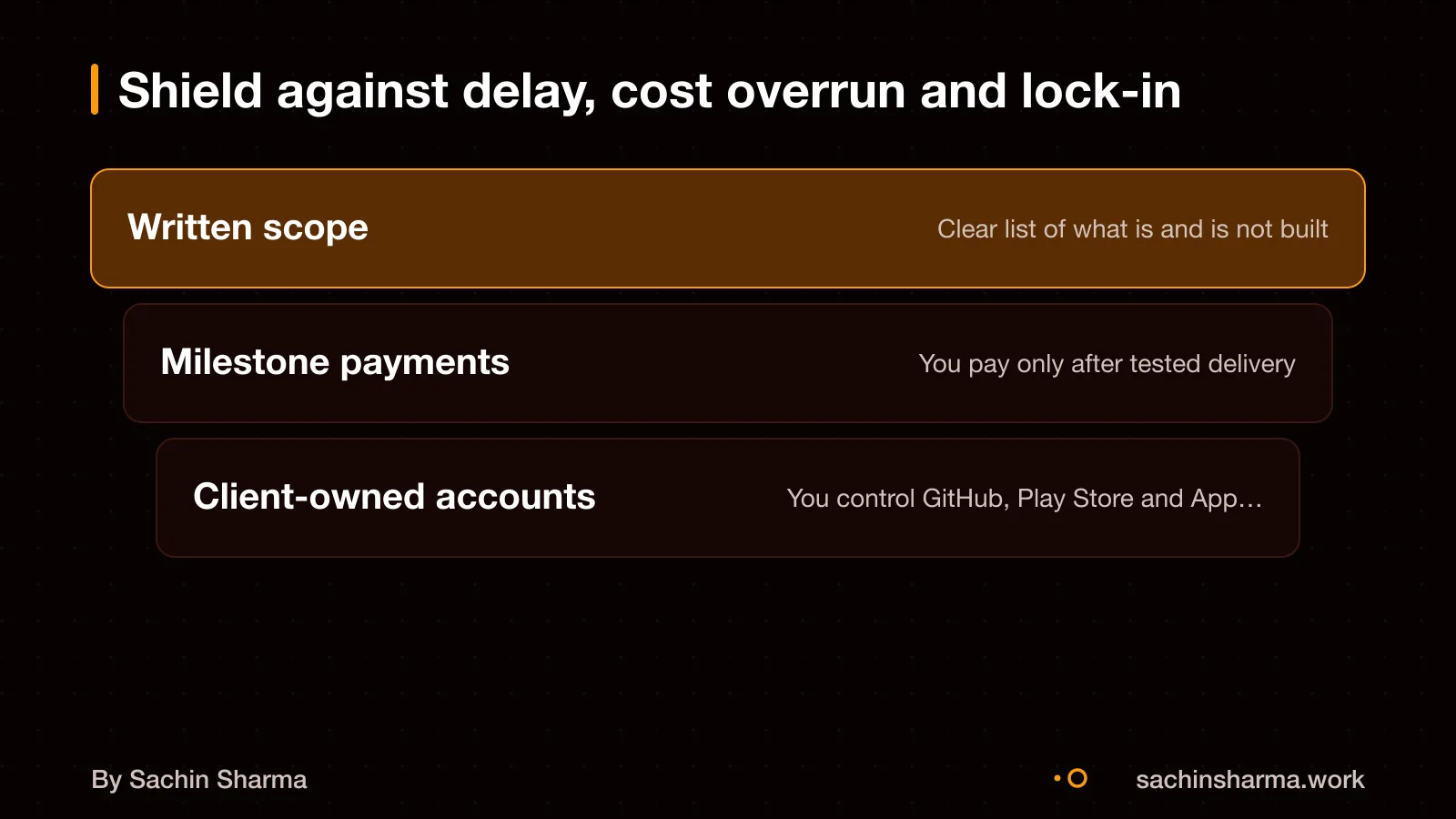
Scope creep and delays happen when requirements change often or you do not get time to review work. We avoid this by agreeing on a written scope that says what is and is not built. You see tested features every two weeks and can adjust plans then. If you are unavailable, development slows until you can review, so your time is key.
Other agencies or platforms may leave you stuck with one developer. If needed, you can switch developers, though I work directly with you and there is no agency layer. Witarist, a developer platform, offers a two-week replacement window at no cost if the fit is not right.
Support and maintenance after launch keep your app working with new OS updates and fix any bugs. As an estimate, assuming regular updates and one major release per year, annual cost is 15 to 25% of build cost. This is not a confirmed quote for my work, as my maintenance terms are not published.
That means you are never locked in. For a deeper look at risk, see Freelancer or agency for a first app? to compare risk profiles.
10 questions to ask before hiring any Flutter developer
Ask about proof of work. Check if the developer shows live apps or public repositories. Avoid those who only share videos or mockups. A real app runs on both iOS and Android.
Check the contract. Confirm that an NDA and IP transfer are signed before any work starts.
Verify the process.
Ensure the agreement meets the legal criteria for a valid contract under Indian law.
Ask how they handle changes in scope. A clear process avoids cost overruns and delays.
Find out if they work directly with you or through an agency. Direct contact cuts delays and miscommunication.
Check if the tech stack is documented. You should know which tools and services the app depends on.
Ask how bugs are fixed post-launch. Support terms should be in writing.
Confirm what happens if the project stops. You must still get the code and assets.
Ask how they protect your data. No developer should store your user data without your consent.
Next step: message me on WhatsApp with what you want to build. No forms, no sales team.
Message me on WhatsAppWhen hiring a Flutter developer is not the right choice
When hiring a Flutter developer is not the right choice A Flutter app is overkill if your goal can be met with a no-code tool or template. For example, if you need a simple booking form or product showcase. Platforms like Instamojo or Shopify with a mobile-optimised site may be faster and cheaper.
Build a website first if your idea does not need offline access, device features (like camera or GPS), or app-store presence. A responsive website works well for content, portfolios or local business listings. See App or website first? to decide.
If your budget is under ₹5 lakh, a full Flutter app may not be feasible. For tighter budgets, consider starting with a focused web tool or a no-code MVP.
Flutter makes sense when you need a feature-rich, cross-platform app. For example, Loopin, an offline-first habit tracker with Google Drive sync, used Flutter. If your app needs similar depth, custom logic or native-like performance, then hiring a developer is the right call.
Your checklist
Before we talk, here is what to check, in the order it hurts to skip. Tick what you have verified; the page tells you where you stand.
Proof
Process
Ownership
Money
Walk away if
- Quotes only a total with no scope
- Won't say who writes the code
- Asks for the whole payment up front
- Keeps the store accounts or repository
- Promises a fixed date without seeing a scope
Questions people ask
It starts with a call to define scope, followed by signing an NDA and IP transfer before any code is written. No code is written before paperwork is complete.
We communicate using tools like WhatsApp and email. You get tested features every two weeks.
You own the code and all accounts from day one. The contract includes IP transfer signed before development starts.
Yes, the code is in your GitHub repository from day one. You can view, audit or back it up anytime. I work directly with you, not through an agency.
You can request changes, but they may affect timeline and cost. We review each change for impact before proceeding.
I work with your designer or can recommend one, but design is not included in core development. For a full workflow, see how I built MojoPlay.
Bugs are fixed as part of a post-launch support window. The exact terms depend on your project’s agreement. The exact terms depend on your project’s agreement.
Yes, I work directly with clients. There is no long-term lock-in.