What you're actually choosing between
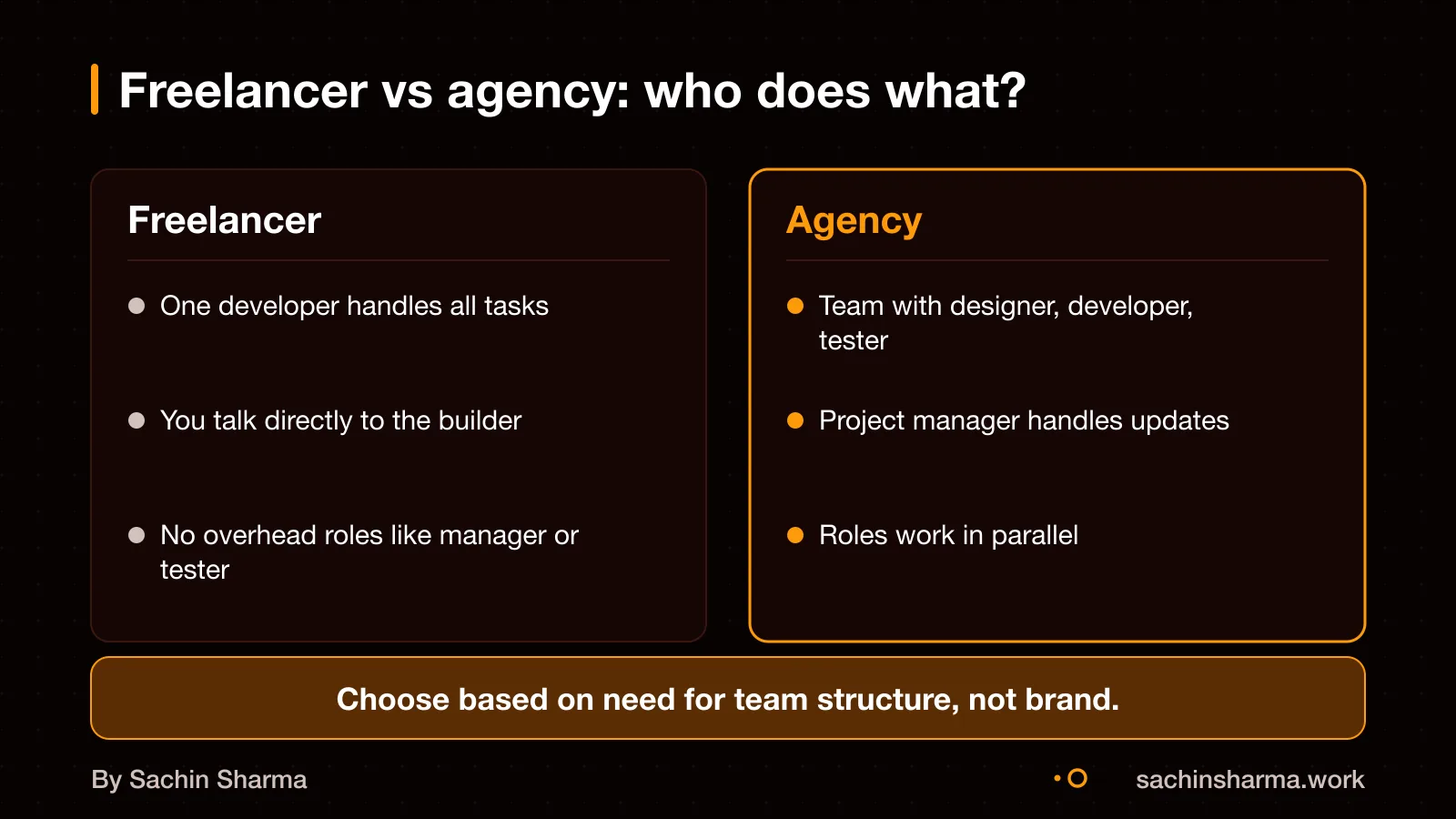
You are choosing between one person handling your app and a team with defined roles. A freelancer is a single developer who works on your app’s tasks directly. An agency provides multiple people, like designers, developers, and project managers, and has processes to manage timelines and quality. The label “freelancer” or “agency” does not tell you about quality or technical skill. Either can build a good app if they have the right experience. In a freelancer setup, that one person does all the work unless they subcontract (which should be disclosed). In an agency, your work may be assigned to different team members, and a project manager will track progress. For a first app with a clear goal, one skilled developer can be enough. If your app needs design, backend, and marketing rolled together, an agency bundles those.
To understand how tech choices affect your app, see how to choose based on real trade-offs.
When to hire a freelancer for your first app
A single-screen tool, MVP, or feature built with one core skill like Flutter or Next.js suits a freelancer best. But full product development carries high risk, especially when multiple skills or IP ownership matter. Projects often run late due to communication gaps, quality issues, or freelancers dropping out mid-way.
The real risk is financial loss. One client lost ₹85,000 after paying upfront outside the platform. Indian businesses lose an estimated ₹200+ crores yearly to such fraud. To reduce failure risk, never pay fully upfront. Use escrow on platforms like Upwork or Freelancer.com. Start with a paid test task under ₹5,000 that delivers a working screen or API. This checks skill, communication, and reliability before you commit more.
If your project needs only one verified skill and you can define every screen and flow, a freelancer can deliver fast and affordably. But only proceed if you can manage scope tightly and protect payments. For broader needs, see when to choose an agency.
When to choose an agency for your first app
Choose an agency if you need multiple skills at once, such as design, backend, and compliance, and want one point of accountability. Agencies can manage complex workflows and formal contracts, which helps when your app must meet strict timelines or legal standards. For example, a multi-tenant platform for a family-run business with ₹150 Cr+ revenue needed coordinated work across teams. Which a single freelancer might not handle alone.
One risk with agencies is hidden costs, such as retainers or kill fees. Another concern is subcontracting: some agencies outsource work to third parties without telling you, which can affect quality and timelines.
To check if the team is real, ask to meet every person who will work on your project. Review their portfolios and confirm they are full-time or dedicated contractors. If they refuse or offer vague descriptions, it may signal subcontracting. You can also ask how they handle handovers between teams and what happens if a team member leaves.
As a buyer, you should verify whether the agency uses offshore developers. This is a key question to ask since the frequency of outsourcing in Indian agencies is not known [unknowns]. For a full picture of what skills go into an app, see what a full app build includes (Mobile app development: what you get from me).
Cost: what you pay and what hides behind the number
A freelancer is often 20 to 30 per cent cheaper than an agency for the same work. This is because freelancers have lower overhead costs like office space, managers, or sales teams. Agencies pass these costs on to you. So for a first app with a tight budget, a freelancer can offer better value.
The monthly cost range for freelancers or agencies in India is not published. But as an estimate, assuming a mid-level developer at ₹1.2 lakh per month, a freelancer might charge ₹1.2 to ₹1.5 lakh. An agency could charge ₹1.5 to ₹2 lakh for the same role, due to the 20 to 30 per cent premium. These numbers depend on experience, tech stack, and scope.
Extra costs may not be included in the quote. Some agencies charge hidden fees like onboarding, project management, or retainers. These are commonly feared but not confirmed in available evidence. Platform fees, such as for app store publishing or cloud hosting, are usually your responsibility. Always ask for a breakdown.
To understand the full cost of building an app in India, see the full cost of building an app in India.
Want a number for your app idea? Send one line on WhatsApp. I reply with what drives the cost and what to cut.
Message me on WhatsAppOwnership: who controls your app and code?
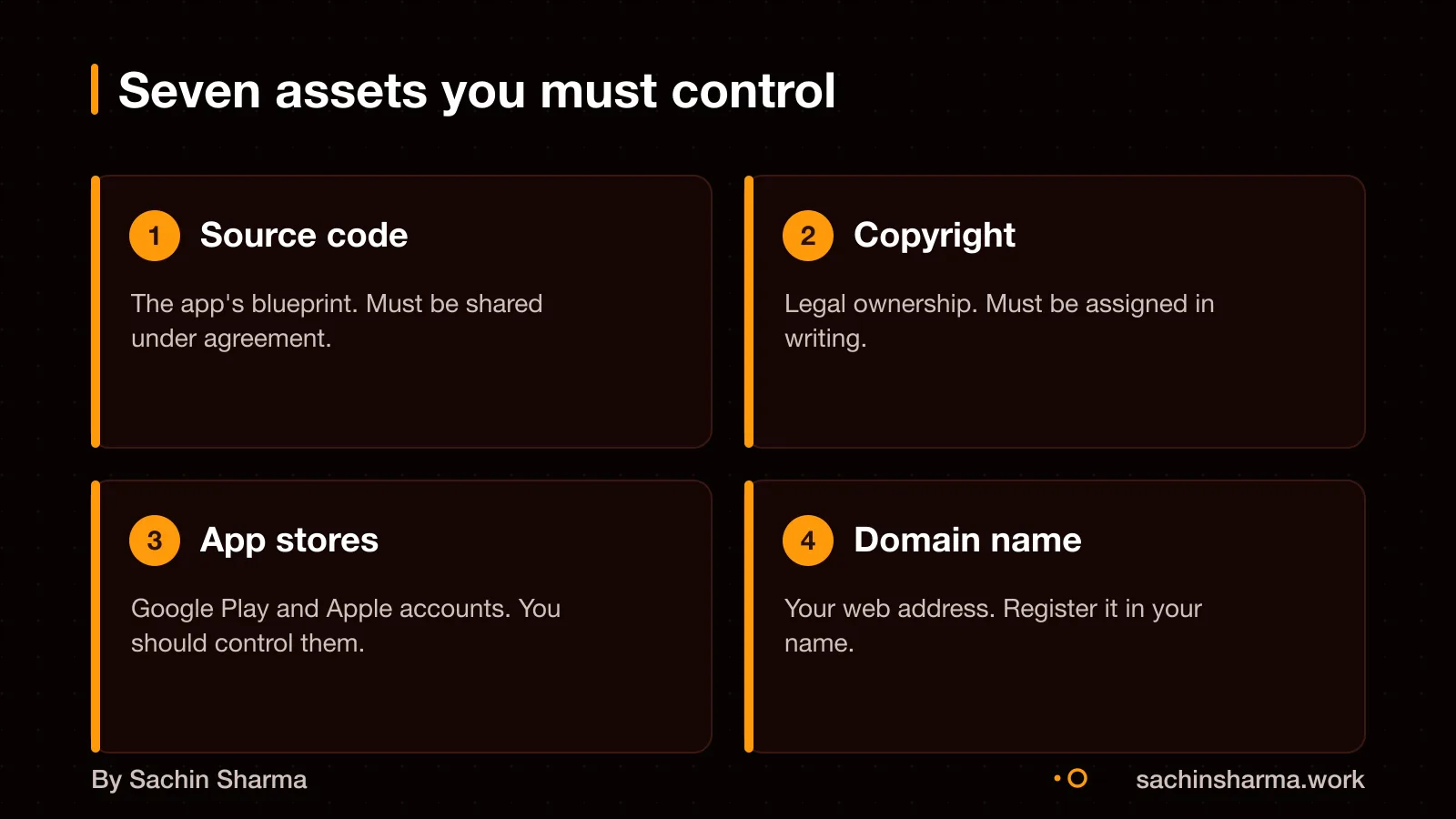
By default in India, the developer who writes the code is the first owner of the copyright, not you. This means your app’s source code, design, and logic legally belong to the freelancer or agency unless a written agreement transfers ownership to you. To gain full control, your contract must include a written IP assignment clause.
App store accounts, domain names, and backend servers and databases should be under your control to protect your data, identity, and ability to update. The app store account must be under your control, otherwise, no one can push updates or manage the listing. Your domain name is tied to your brand; if it’s not yours, someone else can block your emails or website. Backend access ensures you control uptime and data.
For example, in my work on Loopin, an offline-first habit tracker, I ensured full client ownership of code and accounts from day one. Without a written IP assignment, you may pay for development but not own the result. Always confirm in writing who owns each asset before work begins.
Legal: what agreement you need with each
You need a written agreement that includes a non-disclosure clause (NDA) and clear ownership of the final product's intellectual property (IP). This applies whether you hire a freelancer or an agency. The IP must be assigned to you, so you fully control the app and code after delivery. For freelancers in India, most operate as individuals or sole proprietors. Because of this, formal contracts are not always used, but they are still necessary to protect your project. Always get the agreement in writing, even if the freelancer does not have a company registration.
A basic freelancer agreement can include NDA and IP clauses governed by Indian laws. You can prepare one using platforms like Freelancer.com, but tailor it to your project. Never skip the NDA, your idea and data must stay private. As for taxes, the person or entity you pay (freelancer or agency) is responsible for their own tax compliance. Tax deduction obligations depend on GST registration and other factors; consult a chartered accountant to confirm your duties. If the payment to a freelancer exceeds ₹50,000 in a financial year. Tax may need to be deducted under Section 194J of the Income Tax Act (consult a chartered accountant for your obligation). For clarity on tax duties, ask a chartered accountant.
For a sample, see what to check in a developer agreement.
Proof: how to check they can deliver
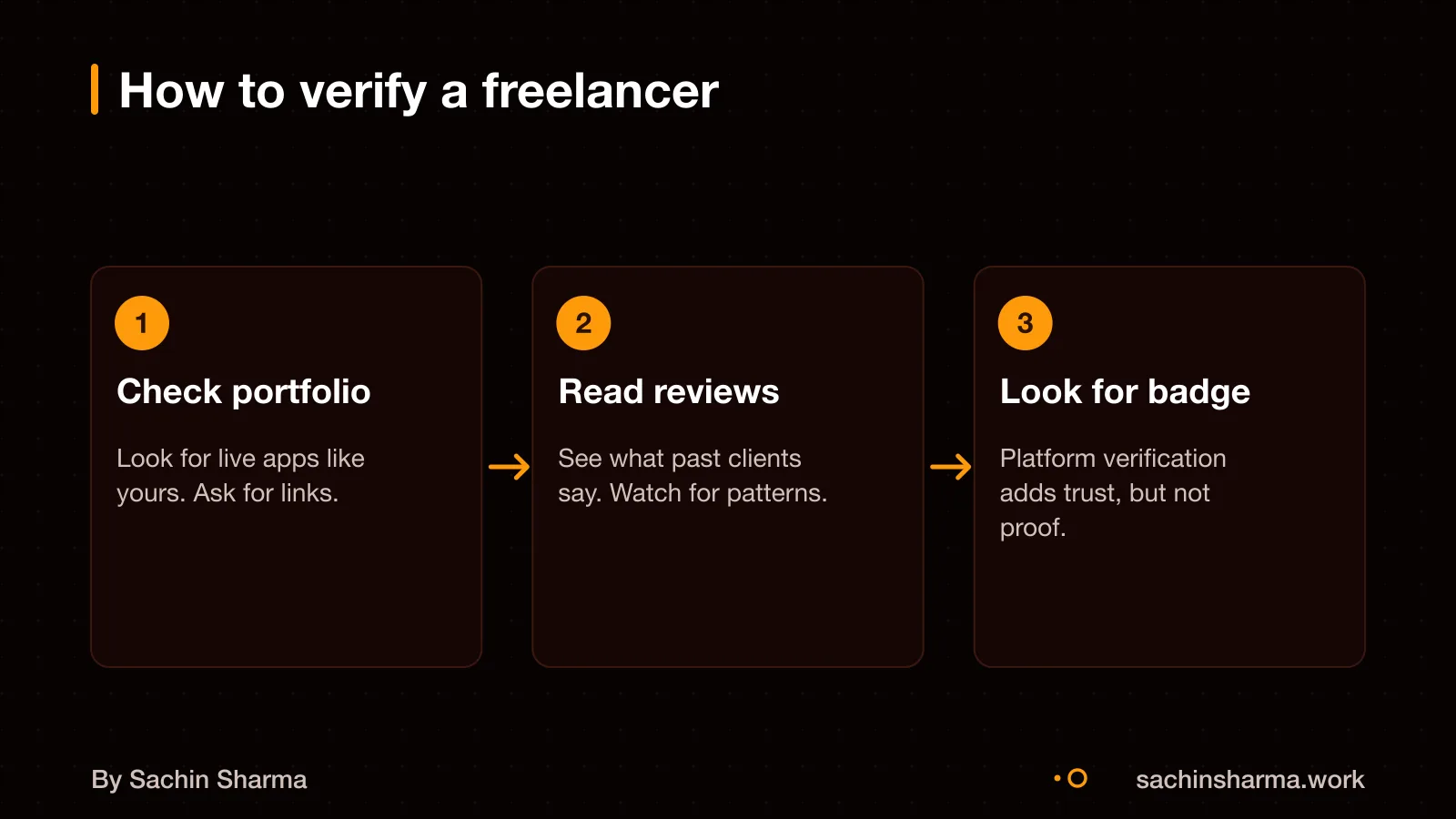
Ask for shipped apps they built, not just promises. A freelancer should show a live app or a public repository you can explore. For example, I publish showcase apps like MojoPlay, a Flutter music app with real-time "Listen Together" sessions, mood-based discovery, and offline playback.
Verify claims by checking if they use trusted platforms. Freelancer.com offers a 'Verified' badge after a video interview. On Grit&Gigs, freelancers submit Aadhaar or PAN to get KYC-verified as of 30 July 2026. These checks help confirm identity but do not guarantee delivery.
Portfolio quality matters more than project counts. Some platforms claim freelancers delivered 350+ or 1,250+ projects, but these numbers are not audited. Focus on apps similar to yours, clear descriptions, and working links. If code is public, check how clean and recent it is.
Checklist: questions to ask both freelancer and agency
Ask every candidate: Who owns the code and app store account? It must be you. Confirm they will sign an NDA and assign all IP rights to you. Ask: Who will write the code? You should know if it is the person you hired or someone else. Ask what happens if you stop the project. You must get all code and data back. Find out what is not included, such as hosting, updates, or support. Use the same list for freelancers and agencies to compare fairly. This helps you spot vague answers.
Next step: message me on WhatsApp with what you want to build. No forms, no sales team.
Message me on WhatsAppWhen this advice is wrong for you
- Do not hire a freelancer if you lack the ability to manage the project or verify their work.
- Do not choose an agency if your budget is under ₹2 lakh per month or your scope is small. Like a single feature or MVP. Agencies carry overhead costs and often require retainers, making them costly for limited work.
- Avoid both if you are unsure whether to build an app at all. First decide if an app solves your business need or if a website or off-the-shelf tool works better.
Pick your situation
I am a solo developer, so I benefit from the first answer. That is why the table below also tells you when an agency is the better pick.
Pick your situation
Freelancer wins. Nothing is lost between a salesperson and the person writing code. A clear scope is the case where one skilled person is fastest.
The whole comparison
| Freelancer | Agency | |
|---|---|---|
| Who writes the code | The person you speak to | Often someone you never meet |
| Cost shape | Day rate or fixed price, little overhead | Higher rates carry the team and process |
| Time to start | Quick, if they have capacity | Slower to staff, steady once started |
| Main risk | One point of failure | Hand-offs and who is really on it |
| Breadth | Deep in a few things | Many specialisms available |
| Accountability | One name | A company and a contract |
Whichever you choose, ask these
- Who exactly will write my code?
- What happens to my code if we stop midway?
- What is not included?
- What does support cost after launch?
Questions people ask
I recommend a freelancer if you need one skilled developer and want to save 20 to 30% on cost compared to agency engagement. For a team with design, backend, and compliance roles, an agency is better. I work as a solo developer, so this aligns with my model.
If you switch from a freelancer to an agency, expect higher costs and more formal processes. If you switch from an agency to a freelancer, you may need to manage more tasks yourself. Team size, control, and budget all shift with the model.
Yes, you can switch models later, but only if your contract gives you full ownership of code and assets. Always keep your app store and backend accounts in your name. For safe transitions, see the page on switching models safely.
It depends on your ability to manage the project and verify work. If you lack technical skills, a freelancer may not be the best fit unless you hire someone to review progress. Clear goals and regular checks are essential.
You could lose money and time. One business lost ₹85,000 to a freelancer paid upfront off-platform. Indian businesses lose an estimated ₹200+ crores yearly to freelance-related fraud. Use escrow, test tasks, and ownership clauses to reduce risk.
The frequency of Indian agencies using offshore developers is not known [unknown]. Some may outsource parts of work, but no data confirms how common this is. Ask each agency directly about their team structure.
Paying full amount upfront is risky. One buyer lost ₹85,000 this way. If possible, use platform protection, escrow, or milestone payments to stay safe.
Whether GST applies differently when hiring a freelancer is not known [unknown]. Rules may vary based on the freelancer's registration and contract type. Check this for your case with a chartered accountant.
Define post-launch support terms in your contract to avoid gaps, as availability varies [unknown].
Yes, but only if they have access to your app store account. You should own the account. Never let a freelancer publish under their name. Keep control to avoid lock-in or loss of access.