What is the real difference between a website and an app?
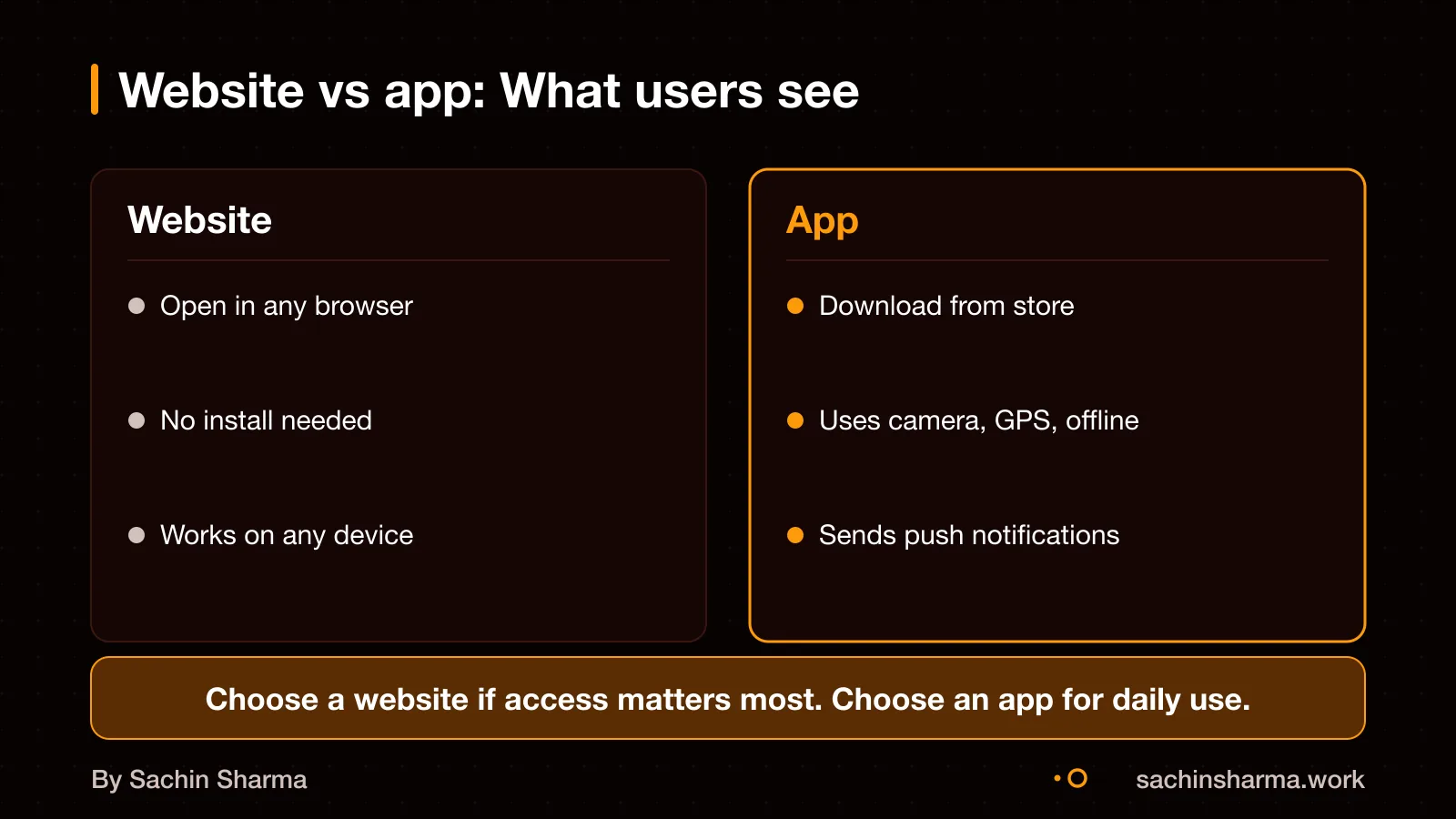
A website runs in your browser and needs no download, while an app must be installed from an app store. You can access a website on any device with a browser, using a single version that works everywhere. Apps can use device features like the camera or GPS, which websites usually cannot. Most websites need internet access, but apps can work offline once installed. A Progressive Web App (PWA) is a middle path. It is a website that can be saved to your phone and used with limited offline features. But even a PWA cannot fully access hardware like a native app can.
Is a PWA enough, or do I need a native app?
A PWA can send push notifications on Android but not on iOS. On iPhones and iPads, Safari does not support push notifications for PWAs, which limits engagement for Indian users who rely on alerts. A PWA can use some device hardware like the camera and location over HTTPS. But iOS blocks access to advanced features such as Bluetooth and NFC that native apps can use.
PWAs work offline and can be installed on any device, giving them an app-like feel. On Android, they are a strong low-cost option. But on iOS, Apple’s browser engine restricts key APIs, making native or cross-platform apps better if you need push alerts or hardware integration. For example, a fitness tracker that logs workouts offline and syncs later can work as a PWA on Android. But if you want to send daily reminders to iPhone users, a native app is needed.
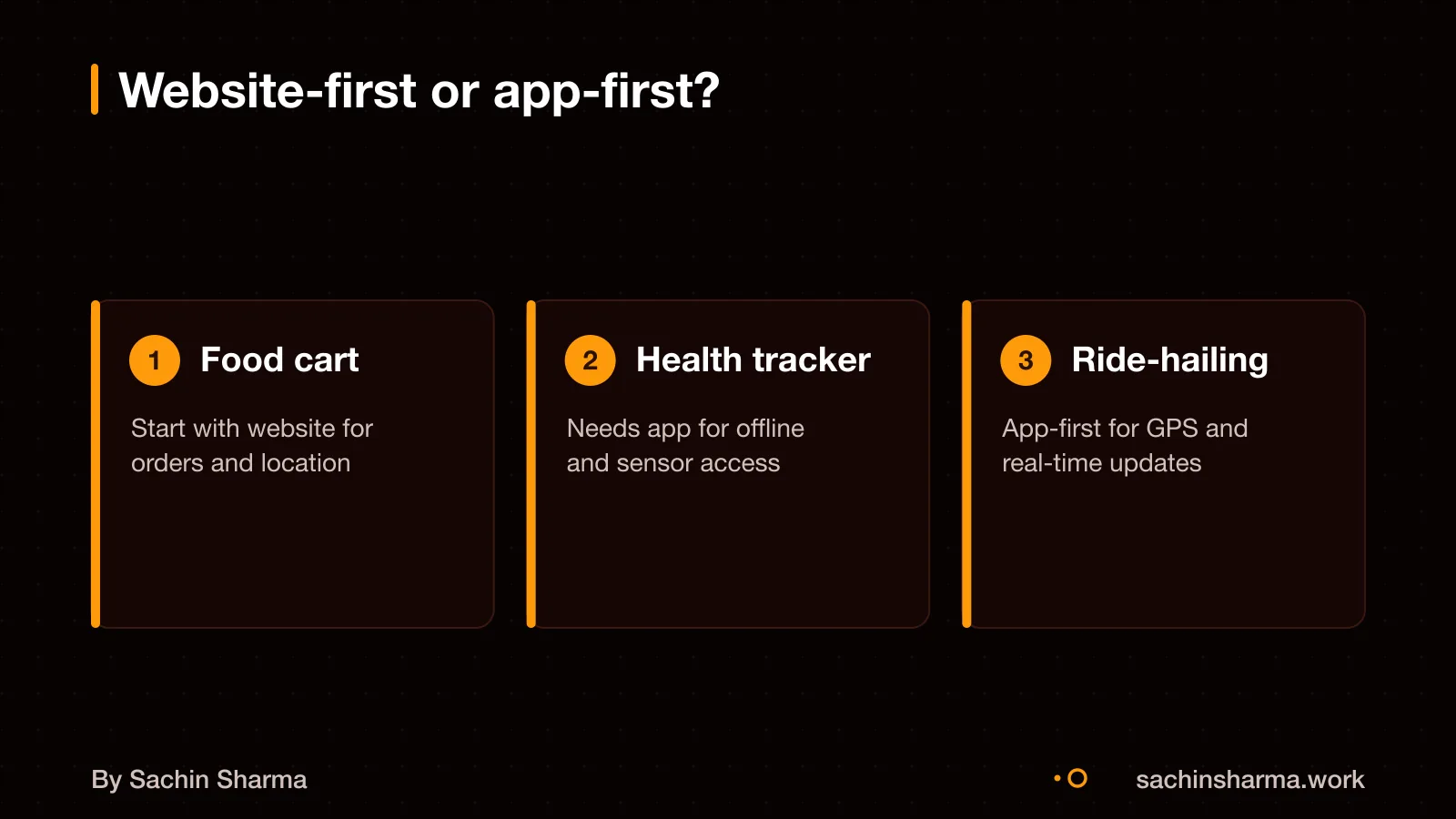
If your users are mostly on Android, a PWA may be enough. But if your business targets iPhone users or needs device-specific features, go for a native or cross-platform app. Learn more about choosing between a native or cross-platform app based on your audience and features.
When should I build a website first?
Start with a website if your goal is fast, low-cost customer discovery. Websites cost less and launch faster than apps. They also rank on Google, so people can find you through search. This helps when you are testing if anyone wants your idea.
If your budget is tight, a website is the smarter first step. You can build a clear, working version for much less than an app. As an estimate, validation itself can cost ₹0 to ₹10,000, often just for a landing page or early conversations.
When you are still testing your idea, a website lets you learn without big risk. You can collect emails, run ads, and talk to users before writing complex code. This reduces waste if the idea needs to change.
Do I need both a website and an app?
When should I build an app first?
A website is often enough for casual use, but an app adds value when users interact deeply with your service every day. For example, MojoPlay supports offline playback and background use. Loopin is an offline-first habit tracker.
An offline-first app ensures users can still use core features without disruption when internet access is unreliable. Mobile apps can store data locally and sync later, keeping the experience smooth. This is harder for websites unless they are built as advanced Progressive Web Apps, which still have limits on offline depth.
Device features are another reason to choose an app. If your idea uses the camera for scanning, GPS for location tracking. Or notifications for reminders, native apps offer better control and reliability than websites. For instance, a field service app for technicians might need photo uploads, live location, and offline forms, all easier in an app.
GENESIS provides Entrepreneur in Residence (EiR) support to students and entrepreneurs to validate startup ideas in Tier II/III cities. It also offers pilot funding support to startups that have validated their idea and need to pilot their product. If your startup requires daily user engagement or offline use, starting with an app could align with user needs. GENESIS supports validation and pilot funding for early-stage startups in Tier II/III cities.
Worked example: cost and time estimates
Worked example: cost and time estimates
As an estimate, a basic website with core pages (home, about, contact, one service) costs ₹1.5 to 2.5 lakh. This includes design, content, domain, hosting and basic SEO. Domain names cost less than $20 for the first year. A monthly tool like Thola starts free and goes to ₹199/month.
As an estimate, a basic mobile app (MVP) with user login, two key features, offline use and push notifications costs ₹6 to 10 lakh. Apps need more testing, two codebases (iOS and Android), app store compliance and ongoing updates. Developing an app typically requires a higher initial investment than a mobile website.
As an estimate, time to build a basic website is 4 to 6 weeks. For a basic app, it is 12 to 20 weeks. These times are not in evidence but reflect typical delivery cycles for custom work. Complex features, integrations or approvals add time.
You save money and time by starting with a website when your goal is customer discovery or basic presence. An app is worth the extra cost only when daily use, offline access or device features are needed.
Want a number for your idea? Send one line on WhatsApp. I reply with what drives the cost and what to cut.
Message me on WhatsAppWhat do Indian users actually do?
There is no India-specific data on user preference between websites and apps for shopping. Wix offers tools to track visitor behaviour and customer engagement. Wix tools can help track visitor behaviour and test what works. But they do not replace direct user feedback from your target audience in India.
However, without local research, you cannot assume your customers will download an app just because others do.
Assume discovery matters unless you have user research showing daily use. If your customers interact weekly or less, a website is likely enough. If they engage daily and need offline access or device features, an app makes sense.
Wix offers website analytics and actionable insights to optimize business and track visitor and customer behavior.
What legal and tax rules apply?
You may need a GSTIN if your annual turnover exceeds ₹40 lakh for goods or ₹20 lakh for services. To get one, you must first have a PAN, which is mandatory for GST registration. If your turnover exceeds ₹10 crore, you may need to generate an Invoice Reference Number (IRN) for B2B invoices under the e-invoicing system. This sends your invoice data directly to the GST portal and removes the need to manually enter it in GSTR-1.
Under the Digital Personal Data Protection (DPDP) Act, you must inform users if your app or website uses automated decision-making, such as AI-driven recommendations. Users have the right to ask for human review or an explanation of such decisions. You must also get clear consent before collecting or processing personal data. For details on setting up consent flows, see the guide on DPDP Act consent flows.
Apple reviews every app before allowing it on the App Store. Your app must meet their technical, content, and design standards. Common reasons for rejection include crashes, incomplete features, misleading metadata, or violating privacy rules. If your app uses AI or collects user data, Apple may ask for detailed explanations during review. Always test your app thoroughly and follow the guidelines to avoid delays.
Can I switch from website to app later?
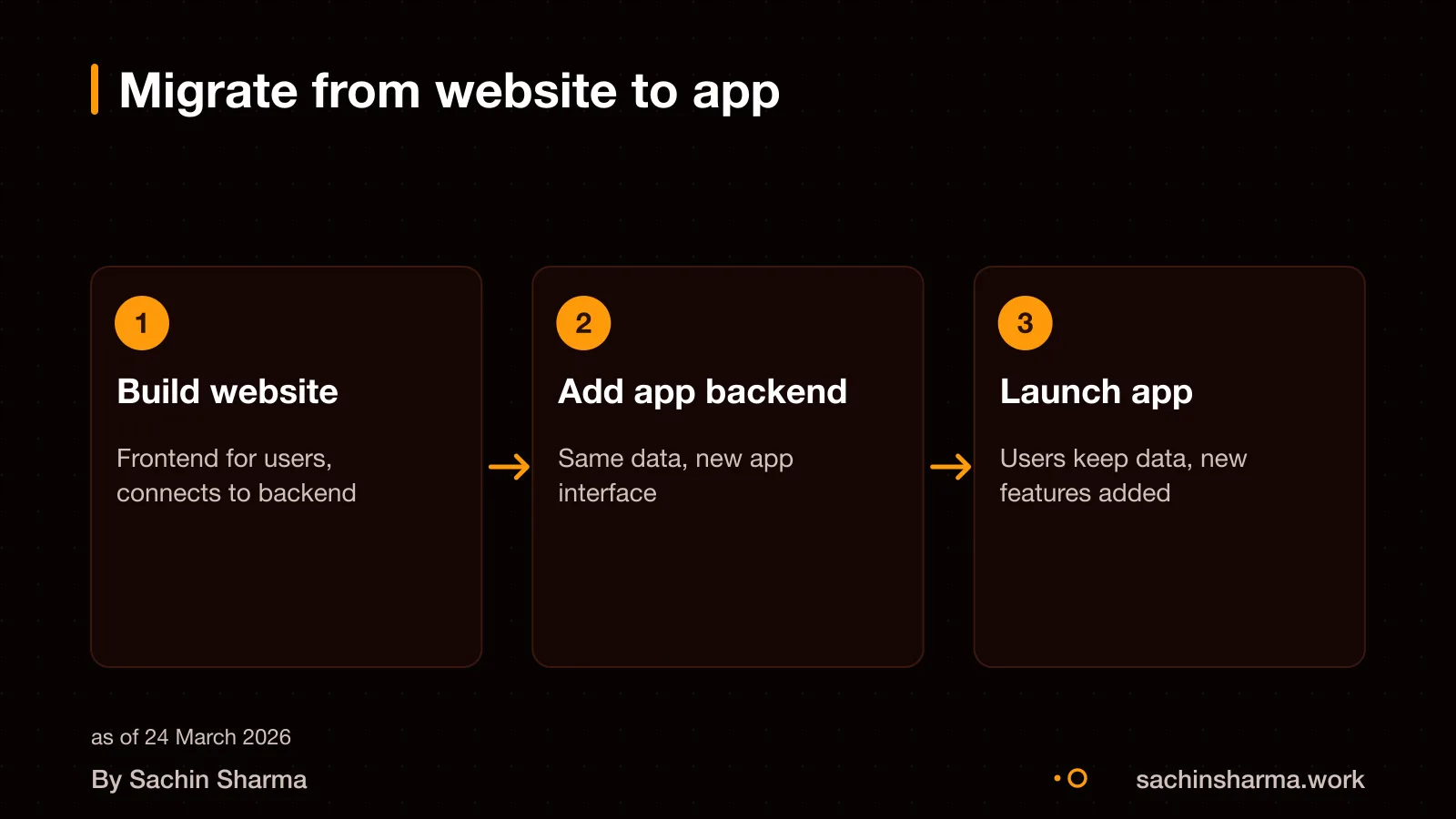
Yes, you can switch from a website to an app later using PWA Origin Migration, and user data can be preserved if done correctly. The process requires a secure handshake between the old and new origins to prevent unauthorised takeovers. Your existing users can migrate smoothly to the app without re-registering.
To migrate users, the old website must explicitly authorise the move by adding a `.well-known` configuration file. This step ensures that only you, as the owner, can approve the transfer. On the new app side, you must declare the old site as the predecessor by adding a `migrate_from` field in the web app manifest.
When you update URLs, keep the old site live during the transition. Redirect users to the new app through clear prompts, and use the same backend database so login and profile data carry over. This method works best when both versions share user accounts and storage.
Starting with a website gives you room to test and grow before launching an app. If you begin with web apps and MVPs in Next.js, the shift to a mobile-ready product becomes smoother.
Test your idea before building
Start by talking to 20 real people who match your target customer. Ask them about their problems and listen closely. If they describe the issue with urgency and already spend money to fix it, that is a strong sign your idea has demand. You can test without writing code, use WhatsApp to share mockups, run a Google Form to collect feedback. Or pre-sell to five people to check if they will pay.
Validation often costs nothing to ₹10,000, as it relies on conversations or a simple landing page, not software. If no one pays, go back and talk to more people, your solution may not match their real need. Build only when you see clear interest.
hire a developer for a small business website if you are ready to move forward after testing.
Have a quote in hand? Send it to me and I will mark what is missing.
Message me on WhatsAppWhen this advice is wrong
When this advice is wrong
Do not build a website or app if your business idea is untested. Start with WhatsApp, Instagram or a simple Google Form to validate demand. If no customer has paid or committed, software will not fix the problem.
Software is not always the first step. For service businesses, begin with manual delivery using tools like WhatsApp, Google Calendar and Excel. Once you have repeat customers and clear workflows, automation makes sense.
Many small businesses in India grow successfully using social media and messaging apps alone. Only build software when you need to scale delivery, reduce errors or handle more volume than you can manage by hand.
Next step: message me on WhatsApp with what you want to build. No forms, no sales team.
Message me on WhatsAppAssumptions behind the numbers
- Initial cost ranges are based on common project scopes in India.
- Time to launch reflects typical timelines for small to medium projects.
- Offline and notification support varies by platform and implementation.
Pick your situation
I build both apps and websites. I benefit if you choose either, but I advise starting with a website to reduce risk.
Pick your situation
App wins. An app installed on the device is easier to open daily than a browser tab. Device notifications also help retention.
The whole comparison
| Website | App | |
|---|---|---|
| Runs on | Any device with a browser | Device with app store (iOS/Android) |
| Offline use | Possible with PWA (limited on iOS) | Full offline support |
| Notifications | Push via PWA (not on iOS) | Native push on all devices |
| Initial cost | ₹0 to ₹10,000 to test | ₹2 lakh to ₹10 lakh minimum |
| Time to launch | 2 to 6 weeks | 8 to 20 weeks |
| SEO and sharing | Searchable and linkable | Needs app store listing |
| Updates | Instant for all users | Review delay on app stores |
Whichever you choose, ask these
- Can I add app features later?
- Will my data move if I switch?
- Do I need both eventually?
- What if I change my mind?
Questions people ask
A mobile app is suitable if users need daily access, work offline, or use device features like the camera or GPS. A website is better for broad reach with lower cost and no download barrier. A mobile website might be the right choice. If your primary goal is to reach a broad audience without the barriers of app stores and downloads.
Yes, you can convert a website to a PWA app later using PWA Origin Migration. But it requires a secure handshake between the old and new origins. The old site must authorise the move by explicitly authorizing the migration. Without this, the migration will not be secure or allowed.
Users will not lose data during migration if the new app declares the predecessor in its manifest using a migrate_from field. The new app must declare the predecessor in its manifest by adding a migrate_from field. This ensures a smooth transition without data loss.
Apps can use device hardware like the camera or GPS in ways that websites cannot access fully. The ChatGPT mobile app supports voice-based agentic features for tasks like drafting documents or summarizing emails. Websites are limited by browser permissions and cannot trigger actions without user input.
You can track user behaviour on a website using built-in analytics tools. These insights help you understand how visitors interact with your content and where they drop off. This data is key for improving your site and testing demand.
Start with one platform and add the other only when user behaviour justifies it. A website is enough for discovery and early sales, while an app adds value for daily users. Building both too soon splits focus and increases cost without proof of need.
If your users are in Tier II/III cities, consider an app if internet reliability is poor, as apps work offline. Startups who have validated their idea can get support from GENESIS for pilot funding. Test with real users before deciding on the format.
Hosting and maintenance costs are not necessarily higher for one over the other. Both need backend hosting, but apps have extra costs for app store compliance and updates. As an estimate, assume ₹20,000 to ₹50,000 per year for updates and hosting. Ask your developer for a quote based on traffic and features.
Yes, you can use the same backend for both a website and an app if it is designed that way from the start. A shared backend keeps data consistent and saves development time. This is standard in modern development using APIs, and I use it in all full-stack projects.