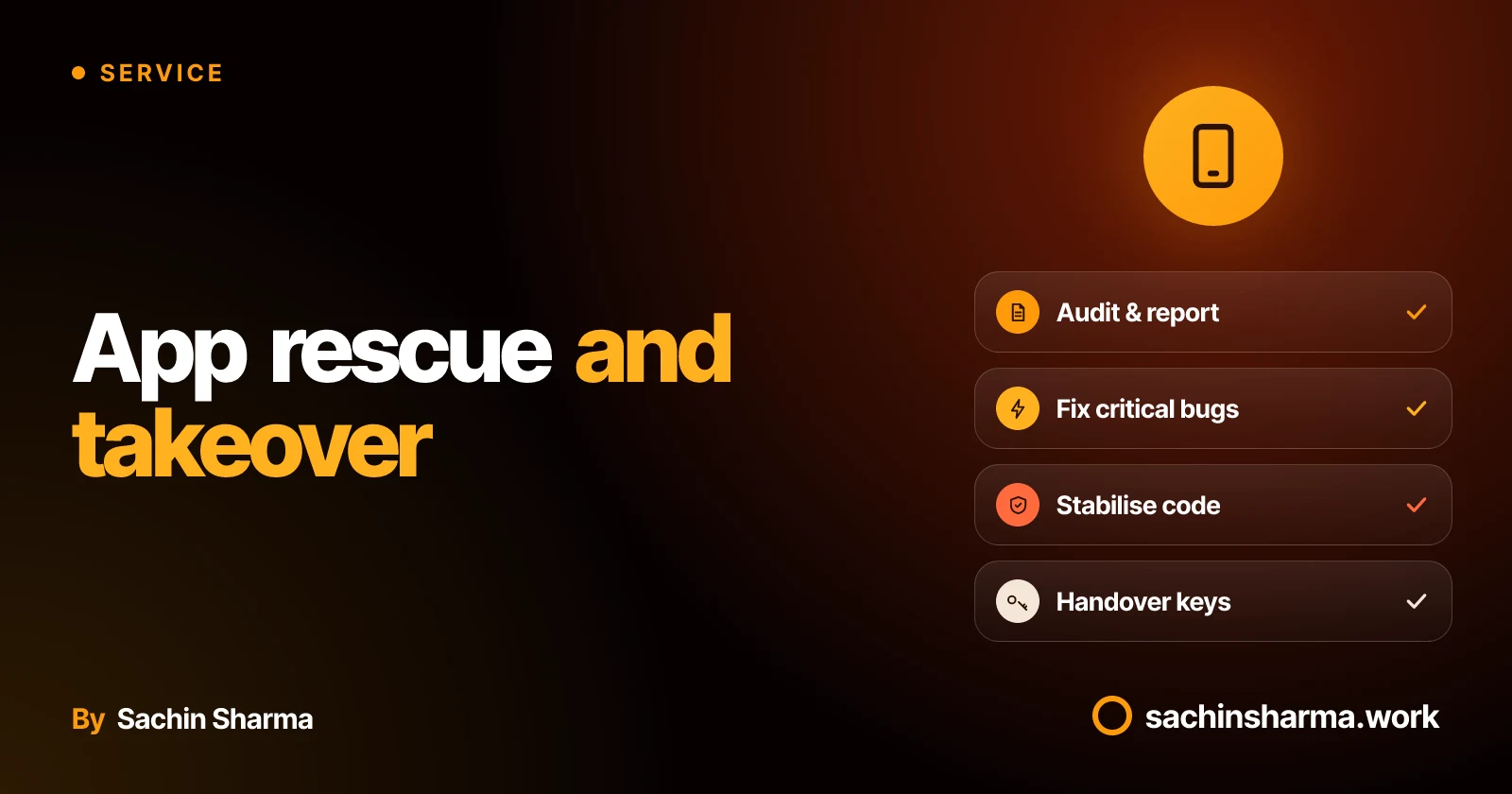
What is a failed or abandoned app?
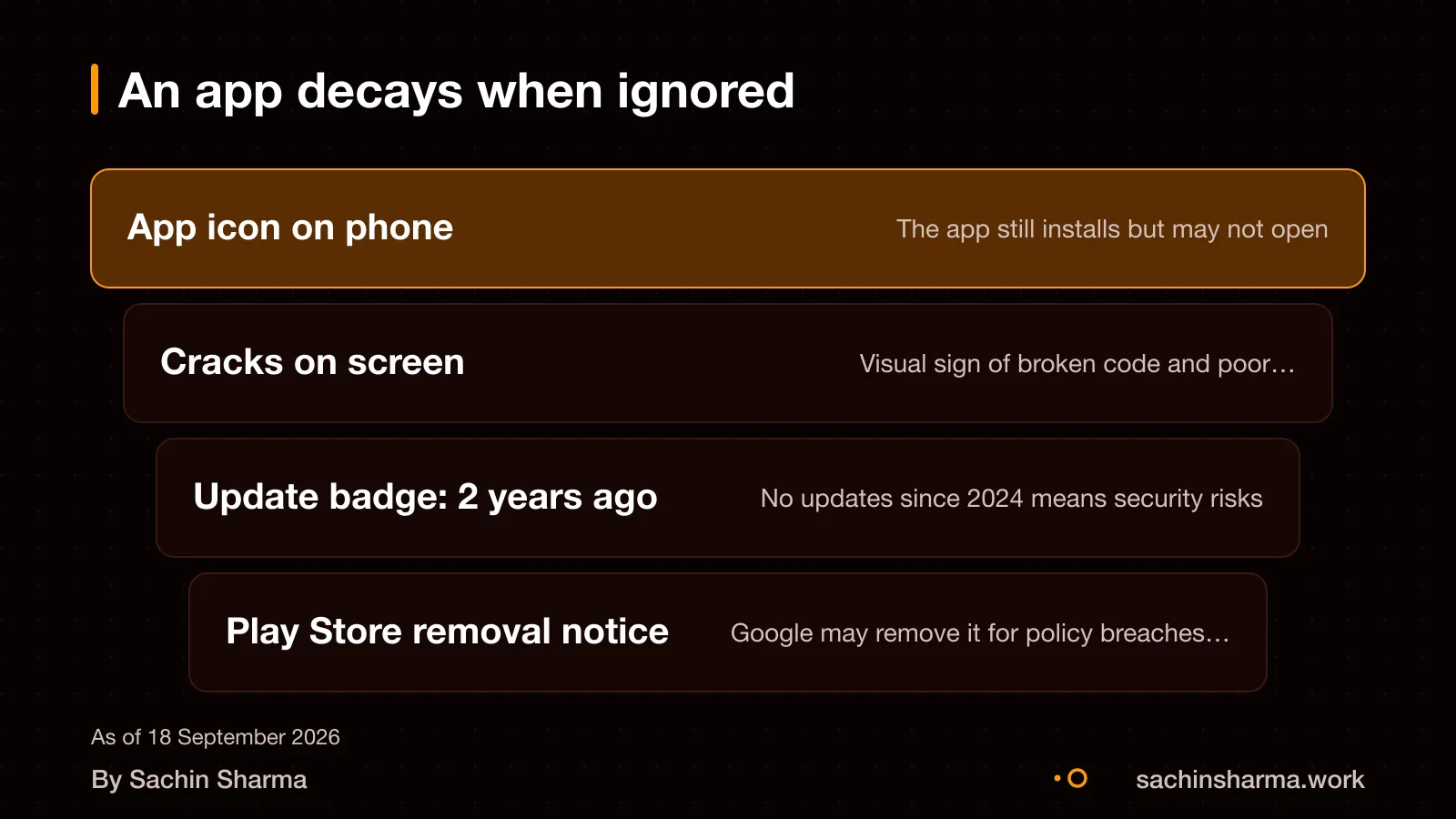
An app is considered abandoned if it has not been updated for two years or has been removed from the Google Play Store. This often means the developer has stopped maintaining it. As of March 2025, 869,000 apps on the Play Store had gone without updates for over two years. Most of these were pulled from the store entirely, while a smaller number remain listed but untouched.
Signs of a failed app include frequent crashes, poor performance, security warnings, or inability to log in. If users can no longer download or use the app reliably, it has likely failed. You may also find broken payment flows, missing data, or no support for current Android versions. These are strong signals that rescue is needed.
Rescue vs rebuild: which is right for you?
Rescue is better when the app’s foundation is sound but parts of it are broken or slow. This includes performance issues, a few failed user flows, or outdated libraries. For example, if login works but payments fail, rescue can fix just that part. A rebuild is cheaper when the data model is flawed, the tech stack is obsolete, or no one understands the code. If the app uses a framework no longer supported, or every change takes too long, starting fresh may cost less. A technical audit helps decide by checking the architecture, data model, dependencies, tests, and API contracts. This short review shows whether the core is fixable or if a rebuild is safer.
How to recover a failed app project System design and architecture
How much does app rescue cost?
As an estimate, assuming a stabilisation cost of $15,000 to 40,000. The audit checks code quality, security, licensing, tech debt and delivery blockers. Stabilisation fixes crashes, bugs and deployment issues to make the app usable and shippable. A full rebuild starts fresh and costs from $40,000 (₹32 lakh). Rescue is often cheaper than rebuilding, especially if core logic works. For example, a habit-tracking app with sync issues may need only backend fixes, not a new app.
Want a number for your idea? Send one line on WhatsApp. I reply with what drives the cost and what to cut.
Message me on WhatsAppHow long does app rescue take?
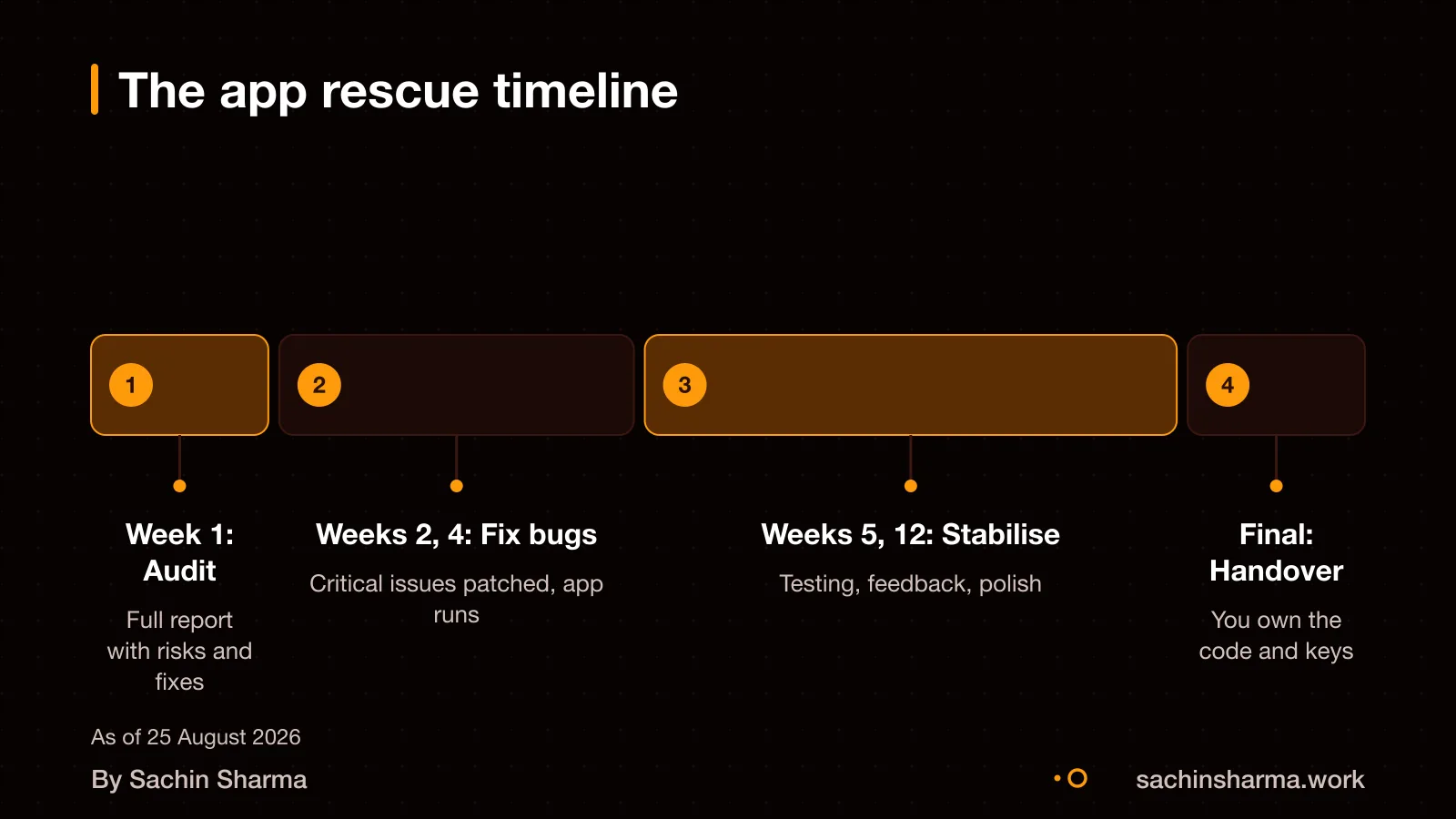
An audit takes 1 to 2 weeks to complete. This is the first step, where I review your app’s code, infrastructure, and documentation to find what broke and why. You get a clear report with risks, a fix plan, and whether to rescue or rebuild.
Stabilising and launching takes 6 to 16 weeks. This includes fixing crashes, updating dependencies, securing data, and restoring core features. The timeline depends on how broken the app is and how much of the original team’s knowledge is available.
For example, a Flutter app with lost backend access and no tests might take 14 weeks. One with working builds and clear logs might take 7. I will give you a firm timeline after the audit.
The app rescue process: step by step
This audit is the product of the first week. The plan lists what is broken, what needs fixing, and what can be deferred.
From that plan, I create a prioritised fix list. This turns your unknown codebase into a fixed-scope, fixed-price engagement. High-risk items, like security flaws, licensing issues or broken core flows, come first. Low-priority items, such as UI polish or non-critical features, are marked for later.
We move from audit to fix only after you approve the stabilisation plan and the fix list. No coding begins until you know the scope, cost and timeline. This keeps risk low and progress clear. If the audit shows the app is too broken to rescue, I will tell you, and suggest whether a rebuild makes more sense.
What is an API?
What if the developer won’t hand over the code?
Yes, you can take over the app even if the developer is unresponsive, but only if your contract assigns you ownership of the code. Legal rights come from the agreement, not who wrote the code. You must have a signed contract stating that intellectual property transfers to you on payment.
To start, you need access to four key things: the source code repository, app store accounts, cloud hosting accounts, and the domain. If these are in your name, you can move forward. If not, you may need to enforce your contract through legal notice.
Not sure if you own the code? Tell me your contract terms and I will say if you can take over.
Message me on WhatsAppProof: apps rescued and stabilised
Yes, apps have been rescued and stabilised for real clients. The EYVA wellness app was a mid-project takeover after a stalled engagement. I delivered working iOS and Android apps with BLE read and write support over eight months. The 360io app was already live but had performance and stability problems. I fixed slow screens, navigation errors and real-time membership sync, and added Stripe payments with Affirm and Firestore-backed store categories. These rescues took months, not weeks, because they involved deep technical work and coordination with live user needs. The exact cost and timeline for your app depend on its state, which an audit will show.
When app rescue is not the right choice
Do not attempt app rescue if the app’s data model is fundamentally wrong or the tech stack is a dead end. Such as an abandoned framework or a platform no longer supported. In such cases, rebuilding may save time and cost in the long run.
An app is unrescuable when there are no tests and no one who understands the code. If every new feature takes longer to implement than it would from scratch, a full rebuild may be better.
If rescue fails, the exit plan is to document what was learned, secure any working components, and begin a rebuild with clearer requirements. Most stalled apps can be rescued.
How do I know if my app’s code is recoverable?
A stalled app is a recoverable asset until proven otherwise. Most stalled builds are rescued, not rebuilt. You can judge this by checking if the core features work, even if slowly or partially. If the app runs without crashing on a test device, it is likely salvageable. The real risk is not messy code but missing access to backend services, expired licenses, or legal ownership issues.
Should I rebuild instead of rescuing?
Only rebuild if the app’s architecture cannot support your roadmap, or if you lack legal rights to the code. For example, if the app uses a deprecated framework with no upgrade path, or. If third-party tools require paid licenses you cannot verify or afford, a restart may be safer. Rebuilding just because the code is hard to read is a waste, clean, working code can be refactored. Focus on whether the app can grow to meet your business goals, not how it looks today.
Will fixing my app take longer than expected?
A competent takeover may move faster than the original build. Once the code is audited and stabilised, progress speeds up because the foundation exists. Delays usually come from unclear goals, missing assets (like design files or API keys), or slow feedback. To stay on track, define exactly what “done” looks like, and respond to updates within 48 hours. The more you delay decisions, the longer the rescue will take.
Related reading: AI features for an app you already have, or from day one, Automate the paper and WhatsApp work in your business.
Next step: message me on WhatsApp with what you want to build. No forms, no sales team.
Message me on WhatsApp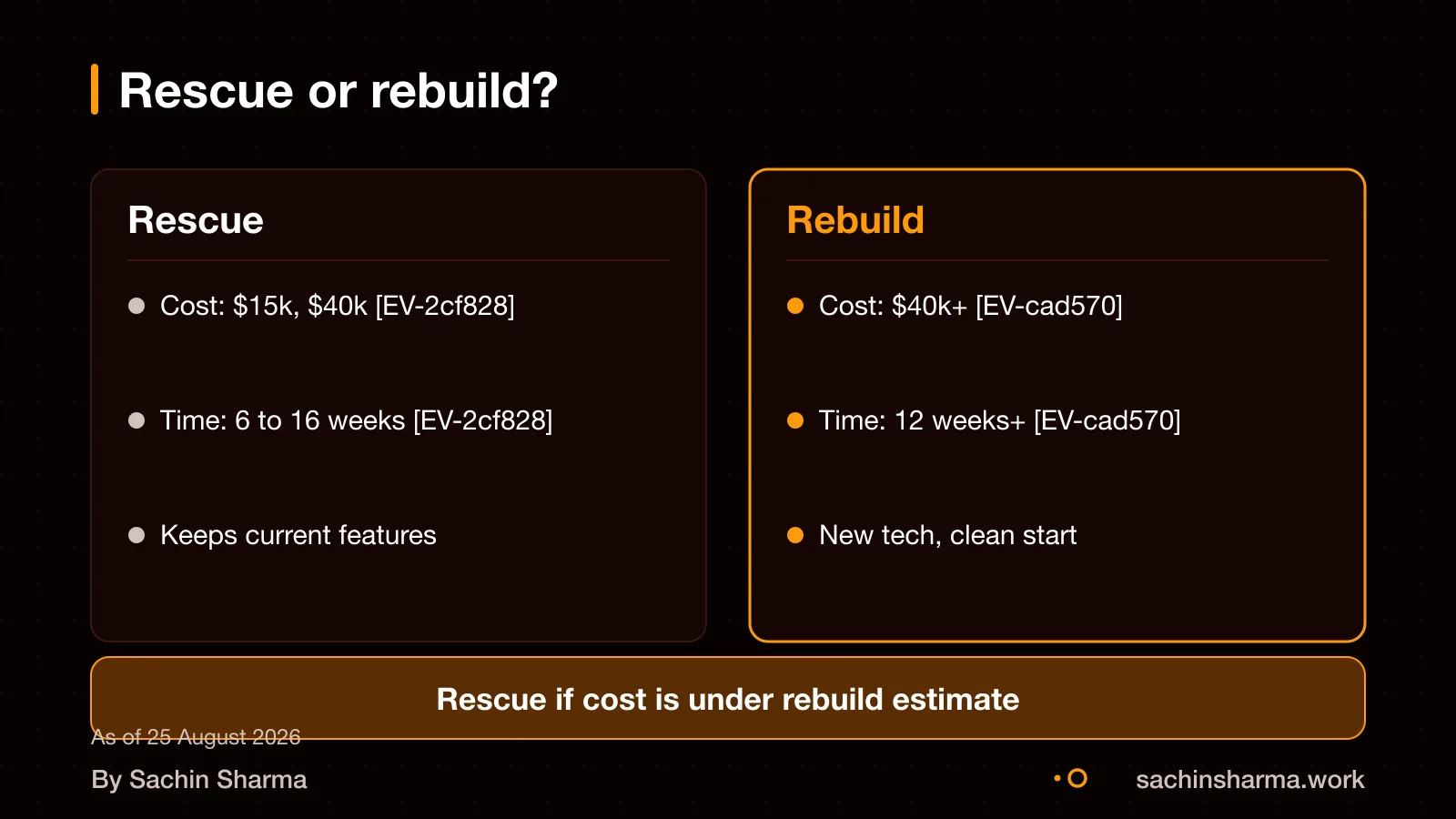
Assumptions behind the numbers
- Audit cost: ₹75,000 fixed (based on $2,500 at ₹80/$)
- Stabilisation cost: ₹4.5 to 12 lakh (based on $15k–40k at ₹80/$)
- Exchange rate used: ₹80 per US dollar
What is in it, and what is not
Taking over a failing app project: audit, stabilisation, testing and handover — all in writing.
- 01Technical audit
Full review of architecture, data model, dependencies, tests and API contracts in 1 to 2 weeks.
- 02Written stabilisation plan
Prioritised list of fixes and a clear path to a stable release in week one.
- 03Fixes and testing
Performance, stability and critical flow fixes with builds shared at each milestone.
- 04Production handover
Final builds, store listings, source code and documentation under your ownership.
How it runs: milestones you can test
- 1Audit complete
You can test: Written report with rescue or rebuild recommendation and issue list.
- 2Stabilisation plan
You can test: Fixed-scope list of issues to resolve, with a timeline and cost estimate.
- 3Testable fixes
You can test: Core flows working, performance improved, crash reports cleared.
- 4Ready for launch
You can test: Release builds, store listings and handover of code and accounts.
Right for you if
- You have a live or nearly-live app that’s stuck or unstable.
- You want to avoid a full rebuild but need real fixes.
- You can provide access to the code, accounts and past team notes.
Look elsewhere if
- The app has no users or clear problem to solve.
- You need a full rebuild due to bad architecture or obsolete stack.
- You’re unwilling to sign a contract assigning IP to you.
How it is priced
Price follows scope. Audit is fixed at ₹75,000. Stabilisation is estimated at ₹4.5 to 12 lakh based on $15k–40k at ₹80/$. Exact cost is confirmed after the audit.
Questions to ask before you sign, with anyone
- Will I own the code and store accounts?
- What exactly is in and out of scope?
- Can I test the app at each stage?
- What happens if we find a rebuild is needed?
- How soon can we start?
Quick answers
Why not rebuild from scratch?
Rescue is faster and cheaper when the data model and core flows are sound. A rebuild is only needed if the base is unsound or the stack is obsolete.
What does the audit cover?
Architecture, data model, dependencies, tests, and API contracts. It gives a rescue-versus-rebuild recommendation.
Do I own the code?
Yes, if the contract assigns IP to you. We advise confirming ownership of the repo, store accounts and cloud access before starting.
Questions people ask
As a general rule, share source code, app store access, cloud accounts, domain, and design files. But your contract decides what you legally own. I cannot verify without seeing it. Check this for your case with a lawyer.
I conduct a technical audit of the existing app.
Yes, I can fix apps that crash. This is part of the stabilisation phase after audit.
Yes, I can work with unfamiliar stacks. Tools exist to check clusters for deprecated APIs. I work with Flutter, Next.js, Node.js, Laravel, Swift, and Kotlin.
Ongoing maintenance is needed after rescue. Support is not included by default. A separate support agreement can be set up after handover.
Communication details depend on the project. We agree on updates and checkpoints at the start. Weekly syncs and decision gates are typical. This ensures clear progress tracking.
GST applies if digital services are sold in India. Domain transfer requires ICANN verification. Contracts must clarify IP ownership. Check this for your case with a chartered accountant or lawyer.
Third-party license compliance is reviewed during the audit. But I cannot guarantee full clearance without full access and legal review. Risks are flagged for your legal team to assess.